
By Eden Jones
The concept of a global flood producing massive destruction and rapid fossil preservation, as recorded in the Book of Genesis is scoffed at today by scientists and the public alike. Museum exhibits, popular science articles and school textbooks tell us that fossils can only form slowly under gradual, local-scale processes observed today over millions of years. Such teachings reflect the principle of Uniformitarianism – the idea that “the present is the key to the past” – founded by Scottish Lawyer Charles Lyell (The University Of Edinburgh, 2024)
But if such a global flood occurred, what would we expect to see?
It is well known that floods today cause widespread destruction and damage, often bringing objects together from different areas and environments and depositing them in one place. One would therefore expect to see a lot of evidence of mass burial in the fossil record. And that’s exactly what we find.

The Creation Research Centre in Oswestry has a huge collection of around 12,000 fossils (Creation Research Centre, 2026). Among these fossils are the bizarre Orthoceras, extinct straight-shelled sea creatures distantly related to octopuses and squids. The museum sign points out that these fossils are buried in their millions in the Ordovician rocks of the Atlas mountains of North Africa. The tips of the pointy Orthoceras shells are all pointing in the same direction, showing that they were deposited by flowing currents.
A similar example can also be seen in the graptolite fossils in the museum, which are also buried in Ordovician rocks. Graptolites were a group of now-extinct tiny marine organisms that lived in small floating colonial chains. These chains form pencil-like structures in the shale, which, like the Orthoceras, are densely buried together in huge numbers and are all pointing in roughly the same direction. The existence of such massive graveyards is consistent with a global flood.

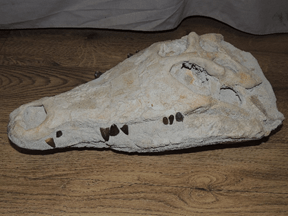
As well as smaller fossils, the museum also boasts an impressive collection of large fossil creatures, including Mosasaurs – enormous extinct marine reptiles that could reach lengths of up to 18 meters, as indicated on the museum sign. These huge creatures are buried in large numbers in the Cretaceous chalk (Everhart, 2001) and phosphate rocks of North America and Africa, respectively.
Vast dinosaur bone beds exist, especially in the Morrison formation of the Mid-Western United States (Nelson, 2014, pp., 70-71). As well as large animals, masses of huge fossil tree trunks and branches occur in the upper carboniferous coal and sandstones of North America and Britain. These fossils are displayed throughout the museum. The presence of large fossil objects buried together en masse testifies to flood action.

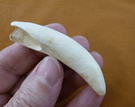
The Creation Research Centre also boasts an impressive collection of Ammonites from the Jurassic limestones and shales of Britain and Germany. These Ammonites were also buried in huge numbers. However, they are found mixed with fossil Araucaria tree branches and leaves. Since Ammonites are marine creatures and trees grow on the land, the only logical explanation for their mixing is that they were catastrophically buried together in a flood. The preservation of such finds also testifies to the catastrophic nature of the flood that had to have buried them before decomposition could ensue and destroy the creatures. Such mixing of environments is also observed in the Cretaceous chalks, where evidence of large marine creatures including sharks and Mosasaurs has been found buried alongside dinosaurs, which were land-based animals (Everhart, Ewell, 2006). The museum even displays a fossil sharks’ tooth from the tree-rich Carboniferous deposits! This is all evidence of water where it shouldn’t be – a flood!
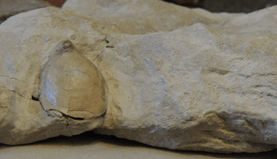
In addition, many fossils found throughout the geological record exhibit preservation of soft delicate structures, such as the feathers preserved on the Archeopteryx fossil from the Jurassic limestones of Germany (a replica of this fossil can be seen in the Creation Research Centre museum). The museum also displays fossil clams that are still closed up. When clams die, their shells quickly open and the two halves are soon separated by currents (Nelson, 2014, pp., 98-99). The fact that these structures, which are prone to decay and disintegration soon after death are still preserved points to rapid, deep burial in sediment. A flood is therefore the most reasonable explanation for these fast fossils.
Finally, many large fossil vertebrates, especially dinosaurs, exhibit a “death pose”, with their heads thrown back, tails curled, and mouths gaping open. This is likely consistent with asphyxiation by drowning, with a lot of water being required to bury large creatures such as dinosaurs (Nelson, 2014., 112-113).
The fossil record therefore abounds with evidence of catastrophic flooding. But how big are the deposits in which these flood fossils are found? The museum signs point out that the Orthoceras fossil deposits can be traced across North Africa, into Czechoslovakia in Europe, across into Asia as far as China and even as far as the USA and Canada! The Jurassic Limestones containing the ammonites and trees are also traceable across vast areas of Western Europe, with similar fossil assemblages displayed in the museum collected from Germany and Britain. The Dinosaur-rich Jurassic rocks of the Morrison formation are also exposed across a vast area of Western North America, stretching from New Mexico to Canada (Nelson, 2014, pp., 70-71). Finally, both the carboniferous coal beds (Smith, 2011) and the Cretaceous chalks can be traced across Europe Westwards across into the Midwestern United States and Eastwards into Asia.
The only reasonable explanation for such global flood deposits is, of course, a global flood! Even the secular geologists come close to acknowledging this when they attempt to explain many of the worldwide sediment layers as the product of rising sea levels, which gradually flooded the continents in distinct past episodes known as “marine transgressions”, such as the famous “chalk sea” of the Cretaceous (Smith and Batten 2002, p.,1). Yet they refuse to arrive at a single worldwide flood because such a catastrophe would completely demolish their pre-conceived view of millions of years of gradual sedimentary deposition.
References:
The University of Edinburgh (2024) Charle Lyell Available at: https://lyell.ed.ac.uk/publications (Accessed: 30/6/2026)
Creation Research Centre (No date) Creation Research Centre – Where dragons praise the Lord Available at: https://creationresearchcentre.com/our-museum-collection/ (Accessed: 30/6/2026)
Everhart, M.J. (2001) ‘Revisions to the Biostratigraphy of the Mosasauridae (Squamata) in the Smoky Hill Chalk Member of the Niobrara Chalk (Late Cretaceous) of Kansas’ Transactions of the Kansas Academy of Science 104(1), 59-78, Available at: https://bioone.org/journals/transactions-of-the-kansas-academy-of-science/volume-104/issue-1/0022-8443_2001_104_0059_RTTBOT_2.0.CO_2/Revisions-to-the-Biostratigraphy-of-the-Mosasauridae-Squamata-in-the/10.1660/0022-8443(2001)104[0059:RTTBOT]2.0.CO;2.short (Accessed: 30/6/2026)
Nelson, V (2014) Untold Secrets of Planet Earth: Flood Fossils. Untold Secrets of Planet Earth Publishing Company, Inc.
Eden Jones is a young student from the UK, who came to do work experience at the Creation Research Centre, Oswestry in 2026. This article is the result of his time and research at the museum, assisted by Joshua McKee and Steve Chedgzoy.






You must be logged in to post a comment.